

IMPORTANT INFORMATION — PROPOSAL
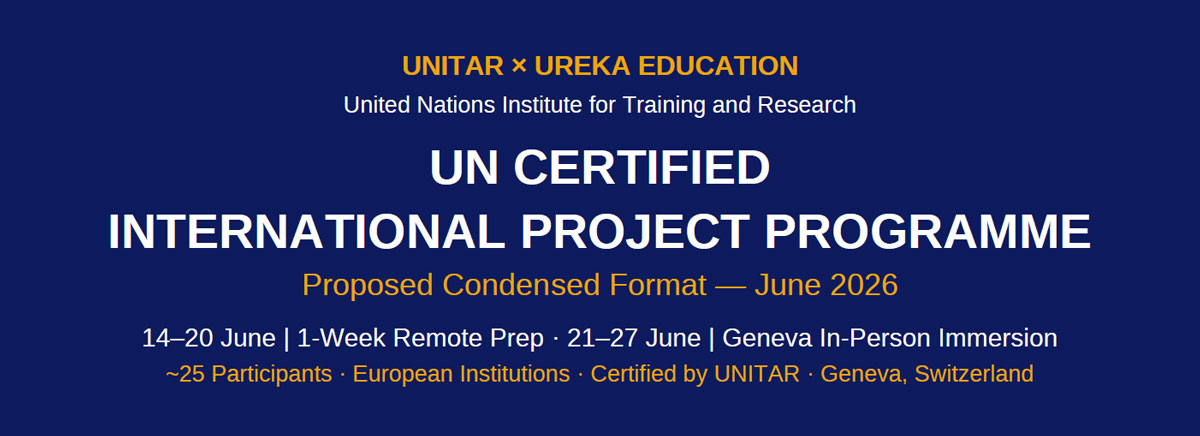
This document is a proposal based on the most recent UNITAR × UREKA International Project Programme, successfully delivered in April 2026. It is intended to give prospective participants, universities, and schools a clear and realistic picture of what the June 2026 edition will look like. The structure, schedule, and activities described here will be very similar to what is delivered — but some elements may be subject to adjustment / changes as advised by the UNITAR programme team prior to the final confirmed itinerary being issued.
This programme is delivered and certified by UNITAR, for any queries regarding the UN credentials, please do not hesitate to request a direct introduction to the UNITAR team.
Before any initial acceptance or enrolment, a dedicated Zoom orientation call will be organised – open to students, parents, and professors or coordinators from the universities and schools receiving this proposal. This session will walk through the full programme, logistics, and expectations, and will include an open Q&A where all questions are welcome.
PROGRAMME FEE : 2,150
Euros per participant · All-inclusive
WHAT’S INCLUDED
Not included: flights to/from Geneva, personal expenses, dinner
PROGRAMME OVERVIEW


WEEK 1 | 14–20 JUNE 2026 — REMOTE PREPARATORY PROGRAMME
The remote week is structured around the same 5-day framework used in the April 2026 edition. Participants work individually and in SDG-themed teams across five focused days, each with a clear deliverable. The pace is intensive but manageable. All live sessions are held via Zoom; async work uses Google Drive, Miro, and WhatsApp.
Team Structure: 6 SDG-themed teams of ~4–5 participants each, formed on Day 1 and carried through into the Geneva week – where they present their final project on Day 6 (Friday 26 June).
DAY 1 – Sun 14 Jun
Welcome, SDG Discovery & Team Formation – Live Zoom Session — 3 hours
Opening – Welcome & Context Setting
UNITAR & UREKA facilitators open. Programme overview, Geneva week preview, housekeeping: Zoom, shared Drive, WhatsApp.
SDG Carousel – Participant Sharing Round
Each participant shares their country context + chosen SDG passion (1.5 min each). Mapped live on Miro board.
Team Formation – 6 SDG-Themed Teams Formed
Groups of ~4–5 aligned to clusters: People & Poverty · Planet & Climate · Prosperity & Economy · Peace & Institutions · Education & Equality · Water, Energy & Cities
Workshop – Team Charter
Each team completes a 1-page Team Charter: names, time zones, communication norms, strengths, and first SDG hypothesis.
Day 1 Task – Ice-Breaker: ‘My Country Card’
Individual async task due before Day 2: 1 slide — a major SDG challenge in your country, a local initiative addressing it, what you personally bring to the team.
DAY 2 – Mon 15 Jun
Individual Research: SDG Deep Dive – Self-paced async work + 30-min team check-in
Morning – SDG Research Sprint (Individual)
Research team’s SDG using UNDP/UN sources: (a) 3 global data points, (b) 1 successful international project, (c) 1 underserved community gap.
Afternoon – Opportunity Brief (Individual)
Write 1-page brief: Who is most affected? What resources/partners are needed? What does success look like in 5 years? Upload to team folder.
Team Check-In – Country Card Sharing + Direction Setting
Share Country Cards. React and exchange on peers’ work. Identify which 1–2 Opportunity Briefs spark most team energy – sets direction for Day 3.
DAY 3 – Tue 16 Jun
Team Collaboration: Problem Framing Workshop – Team virtual meeting — 90 min + async deliverables by EOD
Meeting – 90-Min Team Session
Debate Opportunity Briefs → choose 1 SDG challenge focus. Problem Tree exercise: root causes → core problem → effects. Brainstorm + dot-vote top 2 ideas.
Deliverable – Team Project Concept Note (1 page max)
SDG focus · problem statement · proposed solution · target community · preliminary success indicators. Upload to shared Drive.
Deliverable – Team Role Allocation
Assign: Team Lead · Researcher · Finance Lead · Communications · M&E Coordinator.
Deliverable – 5-Slide Deck for Day 4 Mentor Review
Slides: Context → Problem → Idea → Team → What We Need to Know. Upload by end of day.
Tools – Miro · Google Slides · Google Docs · Zoom breakout rooms
DAY 4 – Wed 17 Jun
Mentor Review: Live Team Presentations – Live Zoom — 2.5 hours — All teams + Mentor
8 min – Team presents 5-slide Concept Note
Each team presents to mentor + full cohort. 20 minutes per team total.
5 min – Mentor structured questions
Is the problem clearly defined? Is the solution feasible? Are stakeholders & beneficiaries named? Does it connect to SDG targets?
4 min – Peer feedback from other teams
One strength + one question per presenting team.
3 min – Mentor guidance & next steps
Mentor summarises key feedback and priority actions for each team before Geneva.
DAY 5 – Thu 18 Jun
Refine, Develop & Close Remote Week – Async teamwork + optional 30-min team call + personal reflection
Morning – Act on Mentor Feedback
Assign each feedback point to a team member. Update Concept Note to version 2. Deepen research where gaps were flagged. Identify 2 potential stakeholders or partners.
Afternoon – Project Foundations
Create simple Work Breakdown Structure (WBS). Map a high-level project timeline for the Geneva week. Draft 5 project risks + mitigation notes.
Reflection – Personal Reflection — 200 words (Individual)
What did I learn this week? What surprised me about working across cultures? What skill do I want to develop in Geneva?
Deadline – Submit Project Concept Note v2
Deadline: Friday 19 June midnight. Weekend: rest and travel preparation. Participants arrive in Geneva on Sunday 21 June.
WEEK 1 DELIVERABLES SUMMARY
Tools throughout: Zoom (live sessions) · Google Drive (shared workspaces) · Miro (problem tree, ideation) · WhatsApp (daily team communication)
WEEK 2 | 21–27 JUNE 2026 — GENEVA IN-PERSON IMMERSION
The Geneva week follows exactly the itinerary planned for the June 2026 programme. Participants arrive with a completed Team Project Concept Note — meaning they enter Geneva as formed teams with clear project direction, ready to deepen, test, and present their work on the final day.
Legend: UN / Institutional Sessions · Outdoor / City Experience · Farewell Dinner (mandatory, own expense)
DAY 1 – Sunday, 21 June
ARRIVAL
Afternoon – Individual / group arrivals — Geneva Airport or Cornavin train station. Hotel check-in.
7:00 PM – Welcome & orientation meeting — week preview, group introductions, practical briefing
8:00 PM – Welcome dinner at the hotel
DAY 2 – Monday, 22 June
9:00 AM – Breakfast at the hotel
10:30 AM – Visit — International Committee of the Red Cross (ICRC)
12:30 PM – Lunch — McDonald’s near ICRC (central, within CHF 15, vegetarian options)
2:30 PM – Visit — Patek Philippe Museum
5:00 PM – Return to hotel — free time, rest, explore the neighbourhood
8:00 PM – Dinner
DAY 3 – Tuesday, 23 June
Palais des Nations
7:30 AM – Breakfast at the hotel
8:30 AM – Meeting at the Broken Chair – Palais des Nations
9:00 AM – Opening Ceremony
9:30 AM – Keynote: DNA of Multilateral Diplomacy – Ambassador Amr Aljowaily
10:30 AM – Guided Tour of the Palais des Nations
12:30 PM – Lunch at the Palais des Nations Café (within CHF 15 budget)
1:30 PM – UN Office – Session 1: Project Management & Professional Skills for Impact
4:00 PM – Session 2: Negotiation Skills and Techniques
6:00 PM – Return to hotel – free evening
8:00 PM – Dinner
DAY 4 – Wednesday, 24 June
Geneva Outdoor Day
8:30 AM – Breakfast at the hotel
10:00 AM – Jardin Botanique de Geneve — outdoor walk with coordinator (free entry)
11:30 AM – Lake crossing by Mouette genevoise — Paquis to Eaux-Vives (CHF 3/ride)
12:30 PM – Lunch at Les Bains des Paquis — lakeside (within CHF 15 budget)
2:30 PM – Guided walking tour of Geneva Old Town — Cathedrale Saint-Pierre, Place du Bourg-de-Four, Maison Tavel
4:30 PM – Free time — Rue de Rive, Confederation Centre, Carouge (shops open, summer hours)
7:00 PM – Return to hotel
DAY 5 – Thursday, 25 June
CERN & ILO
8:00 AM – Breakfast at the hotel
9:30 AM – Depart for CERN — Tram 18 from city centre (~25 min)
10:00 AM – CERN Science Gateway Tour & Briefing by CERN Staff
12:30 PM – Lunch — Coop / Migros takeaway or coordinated pre-order (within CHF 15)
2:00 PM – Visit — International Labour Organization (ILO)
4:00 PM – Tech Hub Panel: AI in Diplomacy — Geneva Graduate Institute, Maison de la Paix
6:30 PM – Return to hotel — free evening
8:00 PM – Dinner
DAY 6 – Friday, 26 June
Final Day at Palais des Nations
7:30 AM – Breakfast at the hotel
9:00 AM – Meeting at the Palais des Nations — Pregny Gate
9:30 AM – Session 3: DNA of Multilateral Diplomacy (Part II) — Amb. Amr Aljowaily
10:30 AM – Session 4: Leadership Skills
12:30 PM – Lunch at the Palais des Nations Cafe
1:30 PM – Session 5: Sustainable Development Goals 2030 Simulation Game
4:15 PM – Break
4:30 PM – SDGs Group Project Presentations — All Teams
6:00 PM – Closing Ceremony & UNITAR Certificate Award
6:30 PM – Return to hotel — freshen up, pack
8:00 PM – Farewell dinner / drinks — all together, restaurant TBD (Students pay their own. Mandatory. The last evening belongs to the group.)
DAY 7 – Saturday, 27 June
DEPARTURE
9:00 AM – Breakfast at the hotel
Flexible – Individual check-outs — airport / station transfers as needed
Ongoing – Depart to home country — safe travels!
KEY LOGISTICS & PRACTICAL INFORMATION
ACCOMMODATION
MEALS & BUDGET
PRE-DEPARTURE ZOOM


CONTACT US — WE ARE HAPPY TO HELP


COORDINATOR’S NOTE
This programme is built on a proven foundation. The remote preparatory week and the Geneva immersion are designed to work as one continuous experience — participants arrive in Geneva not as strangers exploring a brief, but as formed teams who have already researched together, shaped a project identity, and received expert mentor feedback. The Geneva week then does what it does best: it opens doors, deepens thinking, and creates the kind of shared experience that people carry with them long after the certificate is framed.
This programme is delivered and certified by UNITAR. For any questions about the UN credentials, you can write to Mr Mazin Khan at mazin.khan@unitar.org
Organised by: UREKA Education Group — ureka.co.uk
In partnership with: UNITAR — United Nations Institute for Training and Research
SEE IT FOR YOURSELF — IPP APRIL 2026 IN PICTURES
TESTIMONIAL VIDEO
Watch what past participants said about the experience — hear it directly from the students who were there:

Feel free to share this link directly with your students.
https://www.instagram.com/reel/DXxVYb5i8Jp/?igsh=MXF6MDY1aXUycnVrZA==
PHOTOS — IPP APRIL GENEVA WEEK
Browse the full photo gallery from the April 2026 Geneva week — the Palais des Nations, CERN, ILO, ICRC, and the moments in between:

To view the Photo Gallery
Click on the icon provided on the left.
HOW TO APPLY
Applications for the June 2026 edition are open on a rolling basis. Places are limited to ~25 participants — early expressions of interest are strongly encouraged.

Send an introductory email
Write to malak.j@ureka.co.uk with a short introduction about yourself: who you are, which university or school you are applying from, your field of study, and why this programme interests you. Please attach your CV (1–2 pages).

Interview
We will review your message and CV and reach out to schedule a short video call with the programme coordinator – a conversation to understand your motivations and answer any questions you may have.

Payment
Following a successful interview, you will receive a formal offer. We will share payment details to confirm your place. The programme fee is €2,150 per participant. Enrolment is secured once payment is received.

Flight details & arrival
Once your place is confirmed, please share your flight details with the coordinator so your airport transfer can be arranged. Participants arrive in Geneva on Sunday, 21 June 2026.
For more detail contact:
Malak Jaber — Vice President & Principal Coordinator, UREKA Education
E-mail: malak.j@ureka.co.uk
INSTITUTIONS FROM WHERE STUDENTS HAVE JOINED UREKA POGRAMMES
Students joining the UREKA Programmes come from a wide range of leading universities, colleges, and schools across the world. The list below reflects the full breadth of institutions that have participated in UREKA programmes to date — representing a truly global community.

Aberdeen University
Qatar
Abu Dhabi University
United Arab Emirates
Al Maaref American School
United Arab Emirates
Algoma University
Canada
Almaaref American School
United Arab Emirates
Anna University
United Arab Emirates
Arrupe Jesuit University
Kenya
Beloit College
United States
BITS, Dubai
United Arab Emirates
Bombay Scottish
India
Bombay Scottish School
India
BSGE
United States
Cardiff University
China
CECOS University of IT and Emerging Sciences
Pakistan
Concordia University St. Paul
United States
De La Salle University
Philippines
Deira Private School
United Arab Emirates
Doha Secondary School
Qatar
Durham University
United Kingdom
Edge Hill University
United Kingdom
Edge Hill University, Ormskirk, Lancashire
United Kingdom
Emirates National School MBZ
United Arab Emirates
Flinders University
Australia
Gems World Academy Dubai
United Arab Emirates
Georgia Southern
United States
Higher College of Technology
United Arab Emirates
Hochschule des Bundes fur offentliche Verwaltung
Algeria
Holy Family Catholic High School
United Kingdom

Howard University
United States
Institute of International Cultural Exchange
Jordan
Kentucky State University
United States
Kenyatta University
Kenya
Khalifa University
United Arab Emirates
La Salle University
United States
Lancaster University
Germany
Lancaster University Leipzig
Germany
Liverpool Hope University
United Kingdom
Maastricht School of Management
Qatar
Mahopac High School
United States
Mallya Aditi International School
India
Mayoor Private School
United Arab Emirates
Middlesex University Mauritius
Tanzania
Murdoch University
Australia
Pakistan Institute of Development Economics
Pakistan
Philippine Law School / Adventist Univ. of the Philippines / UP Diliman
Philippines
Portsmouth University
United Kingdom
Princess Sumaya University for Technology
Jordan
Qatar University
Qatar
Reading University
United Kingdom
Rukmani Birla Modern High School
India
San Francisco State University
United States
Shiv Nadar University
India
Strathmore University
United States
Symbiosis School for Liberal Arts
India
Team University – Uganda
Kenya
Thammasat University
Thailand
The Baccalaureate School for Global Education
United States
The Knox School
Australia
The University of Jordan
Jordan
United Arab Emirates University
United Arab Emirates
Universidad del Pacifico
Peru
Universita di Corsica
France
Universitat Autonoma de Barcelona
Spain
Universite Cheikh Anta Diop
Senegal
Universiti Brunei Darussalam
Brunei
University College London (UCL)
United Kingdom
University for Management and Economics Skopje
North Macedonia
University of Alberta
Canada
University of Edinburgh
United Kingdom
University of Kent
United Kingdom
University of Lagos
Nigeria
University of Leeds
United Kingdom
University of Pittsburgh
United States
University of Plymouth
United Kingdom
University of Portsmouth
United Kingdom
University of Pretoria
South Africa
University of Reading
United Kingdom
University of the West of England
United Kingdom
University of the Western Cape
South Africa
University of Windsor
Canada
University of Zimbabwe
Zimbabwe
Virginia Tech
United States
Vlerick Business School
Belgium
York University
United Kingdom